
Why Are More Canadian Parents Saying No to Newborn Vitamin K Shots?
As refusal rates rise, are parents being given the full story?
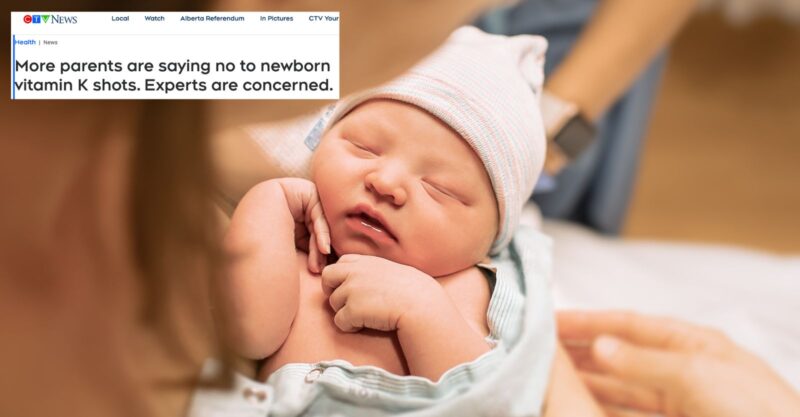
Canadian healthcare providers are reporting a growing number of parents declining routine vitamin K injections for their newborns, prompting concern from paediatricians and hospital officials.
A recent CTV News report highlighted what some experts describe as a troubling trend, pointing to increasing rates of vitamin K refusal in both Canada and the United States. Physicians interviewed by CTV warned that babies who do not receive the injection may face an increased risk of vitamin K deficiency bleeding (VKDB), a rare condition that can result in serious bleeding complications.
But according to physician and researcher Dr. Suzanne Humphries, the public is not being presented with the complete picture.
During a recent appearance on “Good Morning CHD,” Humphries argued that media coverage of vitamin K shots relies heavily on fear-based messaging while minimizing important questions about informed consent, ingredients safety data and the biological role of low vitamin K levels in newborns.
Why Is Vitamin K Given to Newborns?
Vitamin K plays a role in blood clotting, and newborns are naturally born with lower levels of the nutrient than older children and adults.
Current guidelines from the Canadian Paediatric Society (CPS) recommend that all newborns receive a single intramuscular vitamin K injection within the first hours after birth to reduce the risk of VKDB.
Health authorities frequently point to the possibility of severe bleeding, including intracranial hemorrhage, as justification for universal administration.
According to data cited by CTV News, surveillance conducted through the Canadian Paediatric Surveillance Program between 1997 and 2000 identified five confirmed cases of VKDB, translating to approximately one case per 140,000 to 170,000 births.
Why Are Parents Declining?
According to healthcare providers interviewed by CTV News, parents who refuse vitamin K often express concerns about ingredients, preservatives, side effects and the necessity of administering the injection to every newborn regardless of individual risk factors.
Others are questioning whether they are receiving balanced information before being asked to consent.
Humphries argues that many parents are not being informed about ongoing scientific debate surrounding the intervention.
“There’s no such thing as zero risk,” she said during her CHD.TV interview.
Questions About Ingredients and Safety Data
One concern raised by Humphries involves benzyl alcohol, a preservative used in some vitamin K products.
Humphries noted that in 1982, the U.S. Food and Drug Administration recommended that benzyl alcohol be discontinued in neonatal products after concerns emerged regarding its association with “gasping syndrome” in premature infants. While health authorities maintain that the amounts used in vitamin K products are too small to pose a danger, Humphries argues parents should be informed about all ingredients before consenting.
She also noted that while the vitamin K shot contains far less aluminum than many infant medical products, exposure is not zero.
Perhaps more significantly, Humphries questioned claims that the injection has been comprehensively studied for long-term safety.
“We don’t have safety studies that can assure us that there’s going to be no long-term problems,” she said, citing information contained within FDA product labeling.
According to Humphries, studies examining long-term outcomes such as neurodevelopment, fertility and cancer risk have never been conducted.
Revisiting the Cancer Question
Humphries also discussed two British studies from the early 1990s that examined a possible association between injectable vitamin K and childhood cancer.
A 1990 paper published in the British Journal of Cancer reported a statistical association between neonatal drug exposure and childhood cancer, prompting further investigation.
In 1992, epidemiologist Jean Golding and colleagues published a follow-up study reporting nearly double the odds of childhood cancer among children who received intramuscular vitamin K compared with those who did not. The study did not establish causation and has remained controversial.
Subsequent studies largely rejected the proposed association. However, Humphries argues that changes in infant medical interventions over the decades may have complicated efforts to isolate the effects of vitamin K alone.
The issue remains debated, highlighting the importance of providing parents with access to the full body of evidence rather than only studies supporting one viewpoint.
Is Low Vitamin K at Birth Actually a Problem?
Perhaps the most provocative question raised by Humphries is whether low vitamin K levels in newborns are necessarily a deficiency requiring correction.
She noted that humans have been born with naturally low vitamin K levels throughout history and suggested that this physiological state may serve an important biological purpose during the dramatic circulatory changes that occur immediately after birth.
The possibility that low vitamin K levels may be protective rather than pathological has received relatively little attention in mainstream reporting.
“Perhaps it is by design,” Humphries said. “Perhaps there’s a reason for it.”
Informed Consent Requires More Than Reassurance
The growing number of parents declining vitamin K injections reflects a broader shift occurring throughout healthcare.
Many families are no longer satisfied with simple reassurances that an intervention is “safe and effective.” Instead, they are seeking access to original research, ingredient information, potential risks, alternatives and unresolved scientific questions before making decisions for their children.
Whether parents ultimately choose the injection or decline it, meaningful informed consent requires that they be given complete and balanced information.
As questions surrounding newborn vitamin K injections continue to gain attention, health authorities may need to move beyond dismissing concerns as misinformation and engage more openly with the evidence, uncertainties and ethical considerations that matter to parents.
Sources:
CTV News. “More Parents Are Saying No to Newborn Vitamin K Shots. Experts Are Concerned.” May 22, 2026.
CHD’s The Defender. “Watch: Parents Aren’t Getting Full Story on Newborn Vitamin K Shots, Researcher Says.” May 21, 2026.
Former Ontario NICU Nurse Kristen Nagle had a few words to say:
View this post on Instagram
*********************************************************************************************************