U.S. Study Finds Increased Infant Mortality Following 2-Month Vaccination Visit
Analysis of Louisiana Health Department Records Raises Urgent Safety Questions
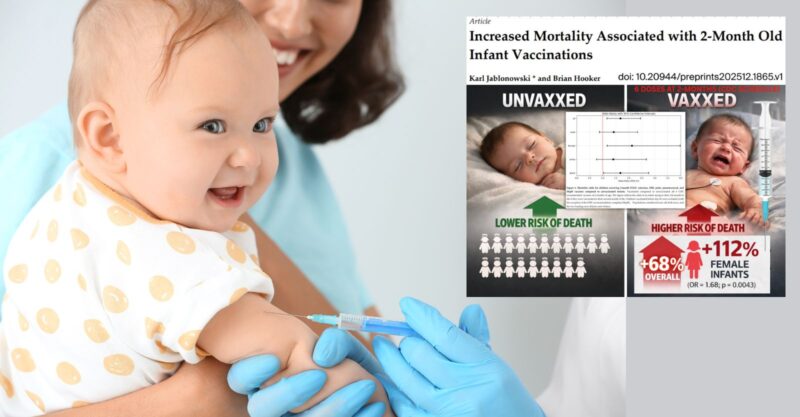
A newly released U.S. study analyzing official Louisiana Department of Health immunization and death records reports a concerning association between routine 2-month infant vaccinations and higher odds of death in the following month, compared to infants who were unvaccinated during the same age window.
The study, Increased Mortality Associated with 2-Month Old Infant Vaccinations, was conducted by Drs. Karl Jablonowski and Brian Hooker, both with Children’s Health Defense. The analysis examined whether vaccines administered between 60–90 days of life were associated with mortality between 90–120 days.
Researchers initially identified approximately 5,800 infant deaths in Louisiana during the study period. Of those, 1,225 infants met strict inclusion criteria — including exact matching between immunization and mortality records and survival beyond 90 days — allowing vaccination status to be accurately evaluated.
The analysis relied on linked, individual-level government records and controlled for age at death, a critical methodological step often absent from vaccine safety research.
Key Findings
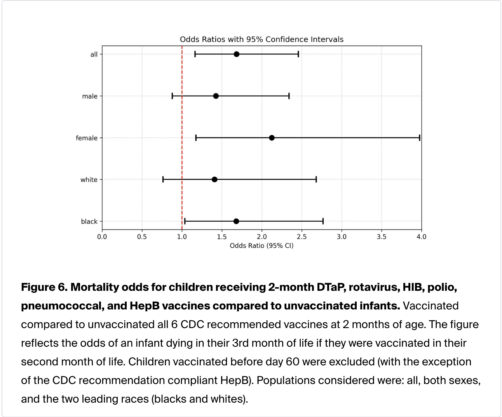
According to the study, infants vaccinated at the 2-month visit showed consistently higher odds of death in the following month compared with unvaccinated infants of the same age.
Reported findings included:
-
+68% higher odds of death overall among infants receiving all six recommended 2-month vaccines
-
+112% higher odds of death in female infants
-
+68% higher odds of death in Black infants
The vaccines examined included DTaP, rotavirus, Hib, polio, pneumococcal and hepatitis B.
Mortality Risk Increased With Cumulative Vaccine Exposure
A central finding of the study was a dose–response relationship, with mortality odds increasing as more vaccines were administered at the same visit.
Compared with unvaccinated infants:
-
Five vaccines: +60% higher odds of death
-
Six vaccines: +68% higher odds of death
Subgroup analyses showed even stronger cumulative effects in female and Black infants, a pattern epidemiologists recognize as a signal that warrants further investigation.
Individual Vaccines Showed Higher Mortality Associations
Each individual vaccine examined was associated with higher odds of death compared to unvaccinated infants during the same age window:
-
DTaP: +42%
-
Hepatitis B: +29%
-
Hib: +35%
-
Polio: +32%
-
Pneumococcal: +41%
-
Rotavirus: +74% (statistically significant)
In every comparison, mortality rates were lower among unvaccinated infants.
Female Infants Experienced the Greatest Risk Increases
Sex-stratified analysis revealed that female infants consistently experienced substantially higher mortality odds than males across nearly all vaccines examined — in several cases approaching or exceeding a doubling of risk.
The authors also reported differences in causes of death. Among vaccinated female infants who died in the 90- to 120-day window, deaths were more likely to occur outside leading categories such as SIDS, including infectious and nervous system conditions — patterns not observed in unvaccinated female infants during the same period.
If vaccinations played no role, the distribution of causes of death would be expected to remain similar between vaccinated and unvaccinated groups.
Combination Vaccines Showed the Strongest Signals
Combination products produced some of the largest mortality associations reported in the study, including:
-
Pediarix® + Hib: +40% overall; +96% in females
-
Pentacel® + HepB: +32% overall
-
Vaxelis® (11-antigen, aluminum-adjuvanted):
+153% higher odds of death overall, with elevated risk in female and Black infants
Vaxelis® exhibited the strongest mortality signal observed in the analysis.
Why This Matters
Public health authorities have long asserted that population-level harms from infant vaccination schedules are too rare to detect. This study challenges that claim by identifying measurable mortality differences using official government data and direct vaccinated-versus-unvaccinated comparisons.
The authors stress that these findings do not end the scientific discussion, but instead underscore the need for independent replication using additional datasets.
When infant deaths are involved, precaution, transparency and open scientific inquiry are essential.
Action Needed: Independent Review and Transparency in Canada
Although this study analyzed U.S. data, many of the same vaccines — and similar combination schedules — are used in Canada.
What You Can Do
Ask Health Minister Marjorie Michel / Health Canada/ PHAC to:
-
Commission independent analyses of Canadian immunization and infant mortality data, including vaccinated-vs-unvaccinated comparisons
-
Release existing safety data in a transparent, accessible format
-
Investigate sex- and race-based differences in vaccine risk
-
Ensure true informed consent, including disclosure of uncertainties
Parents cannot make informed decisions without full access to data and honest discussion of risk.
Horrible.
This is the cause of SIDS.“Louisiana Department of Health death records show infants vaccinated at 2 months are 68% MORE LIKELY TO DIE in the following month than unvaccinated infants…”pic.twitter.com/AlcLaa1AOO
— Liz Churchill (@liz_churchill10) January 7, 2026
Sources:
Jablonowski, Karl & Hooker, Brian (2025). Increased Mortality Associated with 2-Month Old Infant Vaccinations.
Hulscher, Nicolas (2025). BREAKING STUDY: Infant Vaccination Increases Death Risk by Up to 112% vs Unvaccinated. The Focal Points Substack
Baletti, Brenda (2025). ‘Deeply Troubling’: Higher Mortality Rates Detected in Vaccinated 3-Month-Olds Compared With Unvaccinated Infants. CHD’s The Defender.
*******************************************************************************************************