
HHS Secretary Kennedy Appoints New Autism Committee, Signaling Major Shift in U.S. Autism Policy

On January 28, 2026, U.S. Health and Human Services (HHS) Secretary Robert F. Kennedy Jr. announced the appointment of 21 new members to the Interagency Autism Coordinating Committee (IACC)—the federal advisory body responsible for guiding autism research priorities and policy across U.S. government agencies.
The appointments mark a clear departure from decades of narrow, genetics-only frameworks and signal a renewed commitment to rigorous science, clinical reality, lived experience, and prevention-focused inquiry.
“President Trump directed us to bring autism research into the 21st century,” Kennedy said. “We are doing that by appointing the most qualified experts—leaders with decades of experience studying, researching, and treating autism.”
With autism prevalence continuing to rise, the newly constituted committee brings together physicians, researchers, policy experts, advocates, and autistic individuals whose work spans medicine, neuroscience, epidemiology, environmental health, disability rights, and health policy.
Newly Appointed IACC Members
Sylvia Fogel, M.D.
Instructor in Psychiatry at Harvard Medical School and a practicing psychiatrist, Dr. Fogel applies systems biology and family-informed perspectives to autism care. She collaborates through the Autism Innovation Coalition to advance biologically grounded standards of care and evidence-based policy. She serves on the Massachusetts Department of Public Health PANDAS/PANS Advisory Committee and is the parent of a child with profound autism and PANS.
Daniel Rossignol, M.D., FAAFP
A board-certified family physician and clinician-researcher, Dr. Rossignol is Chief Medical Officer of the Autism Discovery and Treatment Foundation. He has authored more than 80 scientific publications, led randomized controlled autism studies, and co-edited A Personalized Medicine Approach to the Diagnosis and Management of Autism Spectrum Disorder. He is also the father of two children with autism.
Elizabeth Mumper, M.D.
Founder and CEO of the Rimland Center for Integrative Medicine, Dr. Mumper is a board-certified pediatrician and former medical director of the Autism Research Institute. Her work has examined inflammation, methylation, cytotoxicity, hyperbaric treatment, and environmental contributors to autism. She has mentored physicians across multiple medical disciplines.
John Rodakis
Founder and President of the N of One: Autism Research Foundation, Rodakis has spent more than a decade supporting clinical research into autism biology, including studies on the gut microbiome, immune function, and metabolism. His work was driven by his son’s diagnosis of severe autism.
Elena Monarch, Ph.D.
CEO and neuropsychologist at the Lyme and PANS Treatment Center, Dr. Monarch has conducted NIH-funded research, published in peer-reviewed journals, and taught at Brown University. Her work focuses on neuroimmune and biopsychosocial approaches to care.
Laura Cellini
A legislative strategist with more than 25 years of experience, Cellini has helped pass landmark autism, immunodeficiency, and neuroimmune legislation in Illinois. She brings both policy expertise and lived experience as the mother of a son who progressed from severe regressive autism to graduating magna cum laude from college.
Jennifer Philips
Founder of Make A Stand 4 Autism, Philips is a parent advocate focused on accelerating effective research and collaboration. Her advocacy began after her daughter experienced profound regression and serious medical conditions at age two.
John Gilmore, M.P.P.
Founder and Executive Director of the Autism Action Network, Gilmore has led national advocacy on autism-related medical rights, education, insurance access, and epidemiology. His work contributed to New York’s ban on thimerosal in vaccines for pregnant women and children.
Caden Larson
A non-speaking autistic adult, Larson studies mathematics at Normandale Community College and serves on the board of Children with Autism Deserve Education. He advocates for spelling- and typing-based communication access through multiple organizations.
Elizabeth Bonker
Executive Director of Communication 4 All, Bonker is a national autism advocate who types to communicate. She works globally to expand access to communication, education, and policy inclusion for non-speaking autistic individuals.
Lisa Wiederlight, M.P.P.
Mother of a young adult with autism, Wiederlight’s advocacy led to the passage of Kevin and Avonte’s Law and to the creation of Maryland’s first Autism Strategic Plan, State Autism Coordinator, and Autism Stakeholder Group.
Toby Rogers, Ph.D., M.P.P.
A political economist and Fellow at the Brownstone Institute, Dr. Rogers researches the regulatory and economic drivers of chronic childhood illness. His doctoral thesis examined toxicants associated with autism risk, and he has testified before the U.S. Senate.
Walter Zahorodny, Ph.D.
Associate Professor of Pediatrics at Rutgers New Jersey Medical School, Zahorodny has directed population-based autism monitoring in collaboration with the CDC for more than 20 years and has publicly challenged genetic-only explanations for rising autism prevalence.
Bill Oldham
Healthcare and technology executive, philanthropist, and founder of the Thought Leadership and Innovation Foundation. Oldham also co-founded Autism First, a family support and therapy organization in Northern Virginia.
Honey Rinicella
Executive Director of the Medical Academy of Pediatrics and Special Needs (MAPS), Rinicella leads the only formal U.S. physician fellowship dedicated to comprehensive autism medical care. She is also the parent of autistic adult twins.
Krystal Higgins
Executive Director of the National Autism Association, Higgins focuses on safety, communication access, medical equality, and preventing wandering and elopement. She is a certified Spelling to Communicate practitioner and former special educator.
Ginger Taylor, M.S.
Parent advocate and former family therapist, Taylor focuses on informed consent, parental rights, and healthcare access for children with complex medical needs. She has contributed extensively to national autism policy discussions.
Daniel Keely
A high school senior diagnosed with autism, intellectual disability, and vision loss, Keely began speaking in second grade and now excels in aerospace interests, aviation, aquatics, and the arts. He is an advocate for individuals with disabilities.
Lisa Ackerman
Co-founder of The Autism Community in Action (TACA), Ackerman has supported more than 100,000 families nationwide over 25 years and helped raise millions for family programs and autism research.
Tracy Slepcevic
Founder of Autism Health Inc. and creator of the Autism Health Summit, Slepcevic is a U.S. Air Force veteran, integrative health practitioner, and bestselling author focused on neuroinflammation, immune dysfunction, and environmental exposures.
Katie Sweeney
Autism and disability advocate focused on communication access and inclusion in the arts. Sweeney serves on the board of CO/LAB Theater Group and works with MAPS while supporting spelling-based communication initiatives.
Why This Matters for Canada…
Although the IACC is a U.S. advisory body, its influence extends well beyond American borders. Canadian health agencies frequently rely on U.S. research priorities, NIH-funded studies, and CDC-linked surveillance frameworks when shaping domestic policy.
A shift toward prevention, environmental inquiry, and whole-body science in the United States raises important questions for Canada—where autism prevalence continues to rise, families face long waitlists, and root-cause investigation remains limited.
By appointing this committee, Secretary Kennedy has taken a decisive step toward restoring scientific integrity to autism research—prioritizing evidence, experience and accountability over dogma. The appointments reflect a deliberate and commendable reset in the direction of autism policy.
Source: U.S. Department of Health and Human Services press release, January 28, 2026
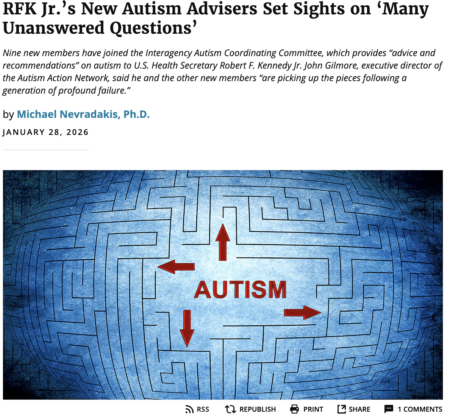
Click on the image to read CHD’s article from The Defender:
********************************************************************************************************************************************************************