

December 11, 2025
Key Points From NEJM Study on Pfizer’s Modified mRNA Influenza Vaccine
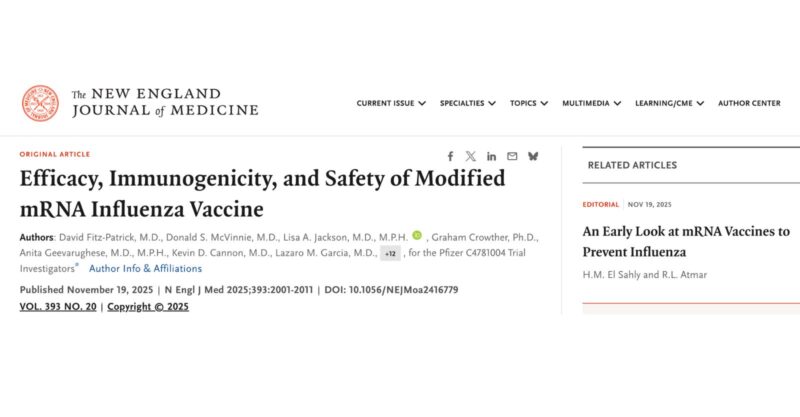
The following summary outlines the major findings from Efficacy, Immunogenicity, and Safety of Modified mRNA Influenza Vaccine, a Phase 3 trial of Pfizer’s modified mRNA influenza vaccine, published in The New England Journal of Medicine (NEJM). It presents the study design, participant characteristics, reported efficacy and documented adverse events exactly as described in the NEJM article and its supplementary materials. This overview is being shared to help readers understand the key data and limitations of the trial.
Modified mRNA Influenza Vaccine Study Summary
November 20, 2025
- Phase 3 Study was conducted and funded by Pfizer
- The control group also received a vaccine, so this was not a vaccinated vs. unvaccinated study. There was no placebo, which is now required by the FDA.
- Total of 18,476 healthy adult participants between the ages of 18 and 64 years were randomly assigned to receive either a quadrivalent modRNA influenza vaccine (9225 were in the modRNA group) or a licensed inactivated quadrivalent influenza vaccine (9251 were in the inactivated quadrivalent vaccine control group)
- Participants were healthy and between the ages of 18 and 64 years, so this was not tested in children, pregnant women or unhealthy people, or medically fragile people.
Study was limited to 14 days for efficacy
- Efficacy, defined by the reduction in the percentage of participants with laboratory-confirmed influenza associated with influenza-like illness at least 14 days after vaccination with the modRNA vaccine, as compared with the control vaccine, assessed reactogenicity within 7 days after vaccination, adverse events through 1 month, and serious adverse events through 6 months.
- The relative efficacy of the modRNA vaccine as compared with the control vaccine against influenza-like illness was 34.5% on the basis of 57 cases in the modRNA group and 87 cases in the control group.
- Cases of influenza-like ill ness were caused by A/H3N2 and A/H1N1 strains but almost no B strains.
Very high number of local reactions in both groups, but higher in mRNA
- 70.1% (almost ¾) of the mRNA vaccine participants had a local reaction vs. 43.1% (almost 1/2) of the inactivated quadrivalent vaccine had a local reaction
- Systemic events: 65.8% vs. 48.7%.
- Fever occurred in 5.6% of the participants in the modRNA group and in 1.7% of those in the control group.
Deaths Reported
- 6 months after vaccination, 16 participants had an adverse event with a fatal outcome (7 in the modRNA group and 9 in the control group);
- None of these events were considered by the investigator to be vaccine-related (Table S12).
- No deaths were reported during the week after vaccination;
- 2 deaths (both in the control group) were reported from day 8 through week 4 after vaccination.

Adverse reactions graph (S10, S11, S12) from NEJM Appendix
Sources:

New England Journal of Medicine (NEJM): Efficacy, Immunogenicity, and Safety of Modified mRNA Influenza Vaccine

NEJM: Conflicts of interest declarations: disclosure

NEJM: Participants excluded from study

Fierce Biotech: Pfizer's mRNA flu vaccine shows 34.5% greater efficacy than standard shot in phase 3

NEJM Evidence: Phase 2 trial Human Challenge Trial of a Nucleoside-Modified Messenger Ribonucleic Acid Influenza Vaccine

Phase 2 trail funded by Pfizer: Conflicts of Interest

Data sharing upon request
************************************************************************************************************