How Toxic Is Your Toilet Paper?
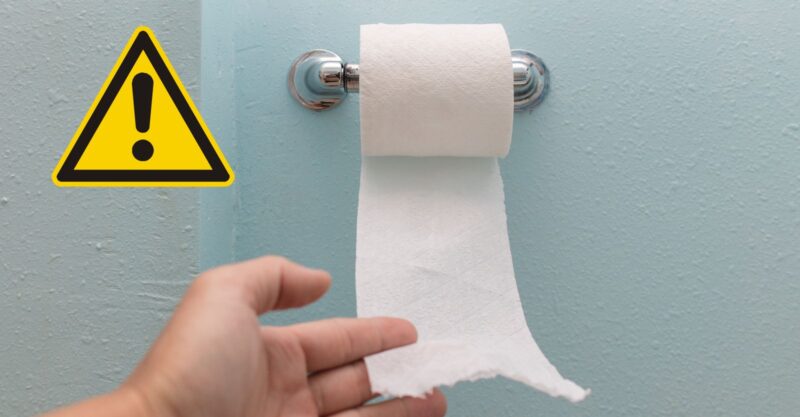
An investigation by Mamavation, originally published in 2022 and updated in 2025, raises important questions about chemical residues in a product most consumers assume is harmless.
The consumer advocacy group screened multiple toilet paper brands for organic fluorine, a marker associated with PFAS (“forever chemicals”), while also highlighting concerns tied to bleaching processes and additives.
Although the laboratory screening focused primarily on products sold in the United States, the findings remain highly relevant to Canadians. Toilet paper is used daily, often multiple times per day, yet consumers are rarely provided meaningful transparency about how these products are processed or what residues may remain.
Hidden Chemicals in Conventional Toilet Paper
When purchasing toilet paper, softness and comfort are typically top priorities. Far less attention is paid to how the product is manufactured — or which chemical processes may be involved.
Conventional toilet paper production can include:
• Bleaching agents
• Wet-strength chemicals
• Fragrances or lotions
• Dyes and inks
• Plastic packaging
Because toilet paper comes into contact with some of the body’s most sensitive tissues, concerns about additives and residues are not trivial.
Bleaching Agents, Additives and Fragrances
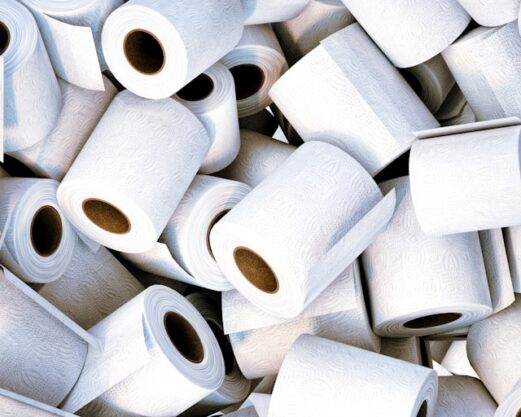
Most white toilet paper is chemically bleached. Even products labeled Elemental Chlorine Free (ECF) rely on chlorine derivatives such as chlorine dioxide.
Historically, chlorine bleaching has been associated with the formation of dioxins, a class of persistent environmental pollutants. While modern manufacturing has reduced emissions, dioxins remain a concern due to their toxicity, persistence and bioaccumulation potential.
For individuals with sensitive skin, bleach residues may also contribute to irritation.
Toilet paper marketed as “ultra-soft” or “luxury” may contain added conditioners, lotions, or binding agents.
These may include:
• Fragrance mixtures
• Wet-strength resins
• Preservatives
• Formaldehyde-releasing compounds
Fragrances are particularly relevant for sensitive individuals, as manufacturers are not required to disclose full fragrance formulations. Such mixtures may contain phthalates or other sensitizing agents.
PFAS (“Forever Chemicals”)
PFAS (per- and polyfluoroalkyl substances) are synthetic chemicals known for their extreme persistence in both the environment and the human body.
Mamavation’s consumer study, originally conducted in 2022 and reaffirmed in its 2025 update, screened 17 toilet paper products for organic fluorine, a marker associated with PFAS. Approximately 24% of the products tested showed indications of PFAS contamination, with measured levels ranging from 10 to 35 parts per million (ppm).
Organic fluorine screening does not confirm specific PFAS compounds nor establish health risk. However, it can indicate the possible presence of fluorinated substances introduced through manufacturing, packaging, or supply chain contamination.
More recent peer-reviewed research reinforces that this is not an isolated finding.
Since the 2022 Mamavation screening, additional research has identified PFAS compounds in toilet paper samples and in wastewater systems that receive toilet paper effluent. A 2023 study published in Environmental Science & Technology Letters detected PFAS, particularly diPAP, in toilet paper collected worldwide. While individual levels were low, scientists emphasize that PFAS are persistent and capable of accumulating in both the environment and the human body over time.
Health Considerations
The presence of chemical markers or potential residues does not automatically translate into disease risk. However, certain health considerations are well recognized.
Fragrances, dyes, and chemical additives can contribute to:
• Contact dermatitis
• Chronic irritation
• Allergic reactions
This is particularly relevant for:
• Individuals with eczema or dermatitis
• Children, whose skin may be more delicate
• Girls, who may be more susceptible to vulvar irritation
Clinicians frequently advise patients experiencing vulvar irritation to avoid scented or dyed toilet paper.
PFAS and dioxins are primarily studied through dietary and environmental exposures. The contribution of toilet paper to total body burden remains under investigation.
Nevertheless, PFAS are known to be:
• Persistent
• Bioaccumulative
• Widely detected in human populations
Reducing Potential Exposures
Consumers seeking to minimize unnecessary chemical exposure often consider:
• Unbleached toilet paper
• Fragrance-free
• Dye-free
• No added lotions
• Plastic-free packaging
Unbleached & Toxin-Minimizing Toilet Paper Options Available to Canadians
• Plant Paper Toilet Paper
• Wype 100% Organic Bamboo Toilet Paper
• Betterway Unbleached Bamboo Toilet Paper
• ECO BOOM Unbleached Bamboo Toilet Paper
• Silk’n Soft Unbleached Bamboo Bathroom Tissue
• BOONBOO Bamboo Toilet Paper (Unbleached)
• Bamboo Story Eco Toilet Paper
• Terre Premium Bamboo Toilet Paper
Gentler Chlorine-Free Processed Options
• Caboo Bamboo Bathroom Tissue
• Caboo 100% Tree-less Bath Tissue
Consumers may also encounter hypoallergenic options, including Canadian brands such as Cascades Fluff Hypoallergenic Bathroom Tissue. While marketed as fragrance-free and dye-free for sensitive skin, most varieties are still bleached using Elemental Chlorine Free (ECF) processing rather than being fully unbleached.
Reducing Toilet Paper Use
Beyond choosing unbleached or fragrance-free products, some consumers are reducing toilet paper use altogether.
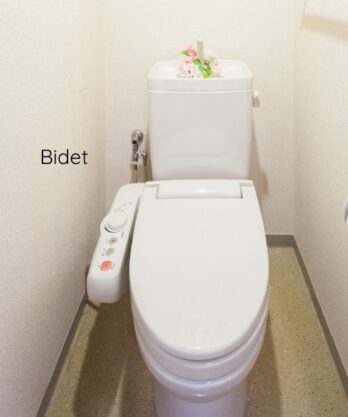 Bidets, long common in many parts of the world, are becoming increasingly popular in Canadian households. By using a gentle stream of water instead of relying exclusively on paper, bidets may:
• Reduce skin irritation
• Lower overall toilet paper consumption
• Decrease repeated exposure to bleached or treated paper products
• Reduce household paper waste
For individuals with sensitive skin, hemorrhoids, postpartum recovery, or chronic irritation, many users report improved comfort.
Canada’s PFAS Phase-Out — and the Disconnect
Canada’s federal regulators, including Health Canada and Environment and Climate Change Canada (ECCC), have committed to phasing out and restricting PFAS due to concerns about environmental persistence and potential health risks.
Yet PFAS continue to be detected in a wide range of consumer products and environmental samples — highlighting the growing gap between regulatory intentions and real-world exposures.
A Call for Greater Transparency
Toilet paper is rarely viewed as a potential source of chemical exposure. Yet both consumer investigations and peer-reviewed research suggest it may warrant closer attention.
For families seeking lower-exposure choices — particularly those with children or individuals with sensitive skin — clearer labeling and greater transparency around processing methods remain essential.
Sources:
Mamavation – Indications of Toxic PFAS “Forever Chemicals” Found in Toilet Paper.
Environmental Science & Technology Letters – Toilet Paper is an unexpected source of PFAS in wastewater
Health Canada/Environment and Climate Change Canada – State of PFAS Report
*******************************************************************************************************************************