
Hidden Arsenic in Children’s Candy Raises Alarming Health Concerns

Candy is often treated as a harmless indulgence for children — a small reward, a party staple, a childhood rite of passage. But recent laboratory testing conducted in Florida suggests that assumption may be dangerously wrong.
🚨 An analysis of popular children’s candies found that roughly 60% contain detectable levels of arsenic, a toxic heavy metal and known carcinogen. Heavy metals such as arsenic and lead are not minor contaminants; there is no safe level of exposure for children, whose developing brains and bodies are uniquely vulnerable. Many of the candies tested are widely sold in Canada, making the findings directly relevant to Canadian families.
What the Candy Testing Found
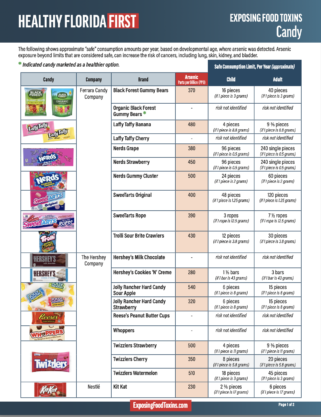
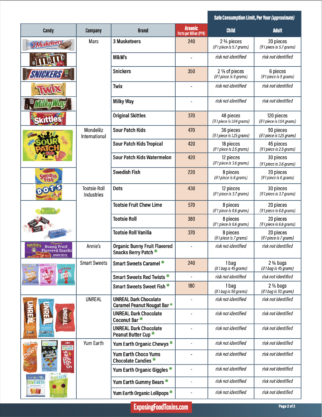
The testing data, compiled and publicly shared by food-safety advocates, examined dozens of mainstream candy products commonly marketed to and consumed by children. Among the candies identified were many household names that routinely appear in lunchboxes, movie theaters, holiday bags, and Valentine’s Day treats: SweeTarts, Nerds, Sour Patch Kids, Skittles, Twizzlers, Jolly Ranchers, Trolli, Tootsie Roll, Snickers, and Kit Kat. The results showed arsenic levels ranging from moderate to extremely high, measured in parts per billion (ppb).
What makes these findings especially concerning is how they translate into real-world exposure. Based on a child’s age and body weight, researchers estimated how many pieces of each candy could be consumed in a year before exceeding conservative safety thresholds. In some cases, that limit was reached after just a few pieces per year.
Many popular candy packages contain dozens — sometimes hundreds or thousands — of individual pieces. This means that routine, everyday consumption, not excessive indulgence, could result in chronic arsenic exposure over time.
Download the full candy testing data (PDF)
Why Heavy Metals in Candy Are a Serious Issue
Arsenic and lead are both well-documented neurotoxins. Lead exposure is widely understood to harm children’s cognitive development, behaviour, and long-term health — and arsenic poses many of the same risks, including increased cancer risk, neurological effects, and metabolic harm.
Children are particularly vulnerable because:
-
Their brains and organs are still developing
-
They absorb toxic metals more efficiently than adults
-
They have a longer lifetime ahead for health impacts to emerge
Unlike acute poisoning, chronic low-dose exposure is difficult to detect and often goes unnoticed until damage has already occurred. Candy, which is eaten repeatedly over months and years, represents a preventable source of cumulative exposure.
A Regulatory Gap That Leaves Parents in the Dark
In Canada, Health Canada monitors heavy metals in food and acknowledges that contaminants such as arsenic and lead can enter the food supply through soil, water, and agricultural inputs. However, there is no transparent, routine, publicly accessible testing program specifically focused on candy products marketed to children.
Even more troubling, many candy products are subject to no specific maximum limits for arsenic, and manufacturers are not required to regularly disclose contaminant testing results. As a result, parents are left to assume safety — without access to the data needed to make informed choices.
The Florida testing highlights a broader systemic problem: regulatory systems often permit exposure first, then respond later, rather than preventing harm before it occurs.
What This Means for Canadian Families
Although the testing was conducted in the United States, many of the brands analyzed are widely available in Canadian grocery stores, convenience stores and big-box retailers. Canadian children are therefore likely consuming the same products — without any clear warning or disclosure.
This raises important questions:
-
Are Canadian regulators independently verifying contaminant levels in candy?
-
Why are products marketed to children not held to stricter standards?
-
Why must parents rely on independent testing to learn what’s in their kids’ food?
Practical Steps Parents Can Take Now
While stronger oversight and transparency are urgently needed, parents and caregivers can take steps to reduce risk:
-
Limit frequent consumption of highly processed candies
-
Prioritize whole-food snacks and homemade treats
-
Be cautious with products aggressively marketed to children
-
Support calls for stronger testing, disclosure, and regulatory reform
A Preventable Exposure
Candy may seem like a small issue in the broader food-safety landscape, but it represents a repeated, unnecessary exposure for millions of children. When products designed for kids contain measurable levels of toxic metals — with no clear limits, warnings, or transparency — it raises serious concerns about whose interests are being protected.
Our children deserve better. Parents have the right to clear information, informed consent and a food system that prioritizes children’s health over industry convenience.
Sources:
60% of Popular Children’s Candies Contain Dangerous Arsenic Levels — The Focal Points Substack
Candy Arsenic Levels and Safe Consumption Estimates — Exposing Food Toxins, Florida
******************************************************************************************************************************