EWG Sues EPA After 7 Years of Inaction on Glyphosate in Oats—Children’s Health at Risk
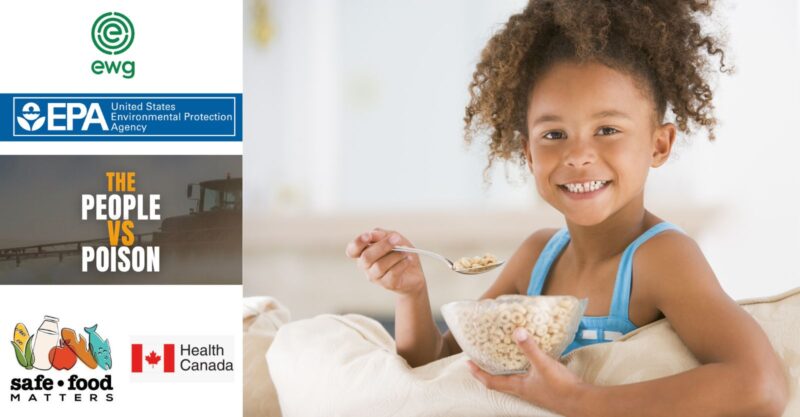
From “The People vs. Poison” to Safe Food Matters, a growing movement is demanding accountability for pesticide exposure across North America as pressure mounts to protect children’s health
The Environmental Working Group (EWG) has filed a federal lawsuit against the U.S. Environmental Protection Agency (EPA), accusing the agency of unlawfully ignoring a petition to restrict glyphosate residues in oats for more than seven years—despite concerns about risks to children’s health.
Filed on April 21, 2026, the case seeks to compel the EPA to respond to a 2018 petition calling for tighter limits on glyphosate in oat-based foods and an end to its use as a pre-harvest drying agent—one of the primary reasons residues are found directly on finished food products.
Oats are a staple in many households, particularly for children. Yet testing over the years has repeatedly detected glyphosate residues in popular cereals, granola bars, and infant foods. Because children consume more food relative to their body weight, they are especially vulnerable to dietary exposures.
A Regulatory Failure Years in the Making
At the heart of the lawsuit is a simple question: how can a federal agency ignore a safety petition for more than seven years?
EWG argues that the EPA’s inaction violates its legal obligations under U.S. law, including requirements to ensure pesticide residue limits are safe for infants and children. Despite this, the agency has failed to respond—while allowable glyphosate levels in oats have increased dramatically over time.
The concern is not limited to regulatory delay. It is also about the underlying science—and whether it has been adequately considered.
Glyphosate has been classified by the World Health Organization’s International Agency for Research on Cancer as “probably carcinogenic to humans,” while other regulatory bodies have reached different conclusions—highlighting ongoing scientific dispute.
Beyond cancer concerns, a growing body of research points to potential links between glyphosate exposure and endocrine disruption, gut microbiome imbalance, and impacts on child development. Critics argue that current regulatory assessments often rely heavily on industry-funded studies and may not fully capture long-term, low-dose exposure risks—especially in children.
Everyday Exposure, Real-World Consequences
Glyphosate is the most widely used herbicide in the world. Its use as a pre-harvest desiccant on crops like oats means residues can remain in foods consumed daily by families.
This creates a pattern of chronic, low-dose exposure—not from a single source, but from repeated consumption of everyday foods.
For children, this matters. Their developing bodies, higher intake relative to weight, and cumulative exposures raise important questions about whether current safety thresholds are truly protective.
For many families, the issue is not just glyphosate itself—but the growing concern that regulatory systems are not keeping pace with emerging science.
A Growing Legal and Public Reckoning
The lawsuit against the EPA comes at a pivotal moment.
On April 27, as we post this, the U.S. Supreme Court is hearing Monsanto v. Durnell—a case that could have sweeping implications for the future of pesticide litigation. At stake is whether chemical companies can shield themselves from liability if their products have been approved by regulators.
Bayer, the parent company that acquired Monsanto, has already paid more than $10 billion to settle claims linking its glyphosate-based herbicide Roundup to cancer, with tens of thousands of cases still pending.
Now, the company is seeking broader legal protections that could prevent future victims from holding manufacturers accountable.
Advocacy groups warn that if successful, this effort could extend far beyond one product—potentially applying to more than 57,000 pesticide products and limiting legal recourse for harmed individuals.
“The People vs. Poison”
A growing grassroots movement emerged in response.
The People vs. Poison has mobilized advocates across the U.S. with a clear message: “We do not consent to being poisoned any longer.”
The campaign warns that while individuals fight to protect their health, governments continue to defend the interests of corporations responsible for widespread chemical exposure—at the expense of public safety.
Powerful voices speaking at the bi-partisan rally outside of the U.S. Supreme Court today included:
- Thomas Massie — U.S. Representative (R-KY)
- Senator Cory Booker – (D-NJ)
- Vani Hari — Food activist, Food Babe
- Del Bigtree — The HighWire, Informed Consent Action Network
- Joel Salatin — Regenerative farmer, Polyface Farm
- Zen Honeycutt — Founder, Moms Across America
- Stephanie Locricchio — Sr. Advocacy Manager at Children’s Health Defense + many more!
All are calling for greater accountability, transparency, and protection of public health in the face of widespread chemical exposure.
At stake is more than one product. If chemical companies succeed in securing legal immunity based on regulatory approval, it could set a precedent shielding tens of thousands of pesticide products from liability—leaving those harmed with little to no legal recourse.
This moment, advocates say, is a turning point—one that will determine whether public health or corporate protection prevails.
You can Watch the rally Replay HERE
🇨🇦 Canadian Context: Holding Regulators Accountable
In Canada, similar concerns are playing out.
National charity Safe Food Matters has been engaged in an ongoing legal challenge since 2017 against Health Canada’s Pesticides Regulatory Directorate (formerly the Pest Management Regulatory Agency (PMRA)) over its continued approval of glyphosate-based herbicides.
Central to this effort is a formal Notice of Objection filed by Safe Food Matters which challenges the scientific basis of the PMRA’s reapproval decision. The Notice calls for greater transparency and raises concerns that key independent studies and real-world exposure risks—particularly for children—were not adequately considered.
As part of its legal action, Safe Food Matters is seeking the establishment of an independent science review panel—a critical step that would require pesticide safety to be reassessed using transparent, unbiased evidence rather than relying primarily on industry-submitted data.
The case argues that current regulatory processes fail to properly account for cumulative exposure, long-term health effects, and the growing body of independent research raising concerns about glyphosate.
If successful, this challenge could significantly reshape pesticide oversight in Canada—setting a precedent for independent scientific review, stronger accountability, and greater protection of public health.
Read more about Safe Food Matters’ case against Health Canada and how to support HERE
A Defining Moment
The EWG lawsuit, the U.S. Supreme Court case, and Safe Food Matters’ legal challenges in Canada all point to a larger shift: a growing demand for accountability.
For families, the concern is immediate—what is in the food being consumed every day, and who is responsible for ensuring it is safe?
For regulators, the question is becoming harder to ignore: how long can action be delayed when credible concerns—and scientific uncertainty—are on the table?
And for the public, the message is increasingly clear: this is not just about glyphosate.
It is about transparency, accountability and our fundamental right to be protected from preventable harm.
Sources:
- Environmental Working Group. EWG sues EPA for 7-year inaction on glyphosate in oats, citing risks to children’s health. April 21, 2026.
- The People vs. Poison. Campaign and rally. April 27, 2026.
- Safe Food Matters. Holding Health Canada Accountable on Glyphosate. March 27, 2026.
****************************************************************************************************************************************