
CDC Votes to End Universal Hepatitis B Shot for Newborns — What Canadians Should Know
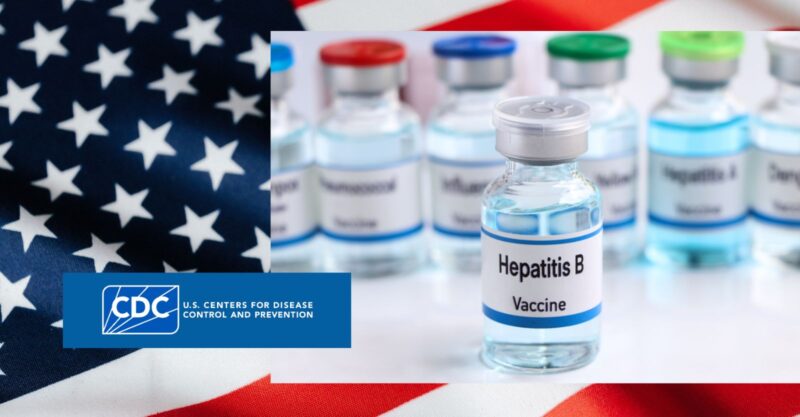
In a major shift, the U.S. Centers for Disease Control and Prevention (CDC) has ended its long-standing recommendation that all newborns receive the Hepatitis B (Hep B) vaccine within 12–24 hours of birth.
Instead, for babies born to mothers who test negative for Hep B, the CDC now says the decision should be made by parents together with their physician — not automatically at birth.
This marks the first time in over three decades that the CDC has backed away from a universal newborn vaccination recommendation.
What the CDC Decided
-
Universal Hep B shot at birth is no longer recommended for babies whose mothers test negative.
-
Parents may now choose based on individual risk, with support from their healthcare provider.
-
If parents decline the birth dose, the earliest recommended time for the first shot becomes 2 months.
-
The birth dose remains recommended only for infants whose mothers test positive or whose status is unknown.
The vote was not unanimous. Three members of the CDC’s vaccine committee (ACIP) opposed the change, while eight supported it.
Children’s Health Defense CEO Mary Holland, Esq. called the vote:
“a long-overdue correction to an ill-considered universal policy,” noting the lack of safety data, the inadequate clinical trials, and the fact that the original push for universal newborn Hep B shots in 1991 had little to do with newborn health.
A 1991 New York Times report, resurfaced this week, confirmed that public health officials openly stated the goal was to reduce adult Hep B cases — because adults were not voluntarily taking the vaccine.
Why This Matters
The Hep B shot at birth has always been controversial because:
-
Less than 0.5% of mothers carry Hep B.
-
Mothers are usually tested during pregnancy and again in hospital.
-
Hep B is bloodborne, not casually spread — infants without exposure are at extremely low risk.
-
Original clinical trials followed infants for only days, with virtually no long-term safety studies.
ACIP member Retsef Levi, Ph.D., compared giving newborns a poorly studied vaccine to “flying in a plane that wasn’t safety tested.”
How This Compares to Canada
This U.S. policy change raises important questions for Canadians.
While New Brunswick, Nunavut and Northwest Territories recommend administering Hep B vaccine at Birth, most other provinces, begin Hep B vaccination later in childhood — either at 2 months or 12 years old unless the mother is Hep B positive. (including Ontario, Quebec, British Columbia, Alberta, Saskatchewan, Manitoba, Newfoundland & Labrador, PEI, & Nova Scotia)
This new USA Hep B vaccine shift matters for Canadians because:
-
The CDC strongly influences Canadian public health decisions.
-
A major U.S. reversal often prompts review of Canadian practices and could result in a renewed push for increased Hep B vaccine recommendations for Canadian infants.
-
It highlights the importance of parental choice, individual risk, and informed consent — principles Canadian families continue to fight for.
Why This Change Happened
During the two-day ACIP meeting, members debated:
-
the absence of rigorous safety data,
-
concerns about informed consent for mothers immediately after labour,
-
conflict-of-interest issues within professional organizations,
-
and the increasing recognition that many vaccine recommendations function like de facto mandates.
Even CDC staff acknowledged that recommendations often become requirements for school entry, despite being labeled as “optional.”
What Families Can Do
For Canadian parents and grandparents:
-
Know your province’s schedule.
-
Ask for full information about risks, benefits, and alternatives — especially when a recommendation is presented as routine.
-
Keep informed as U.S. policy changes often influence Canadian decisions.
-
Support transparency. Public pressure is essential to ensure vaccine recommendations are based on science, not convenience or politics.
The Bigger Picture
This vote signals something important:
Government vaccine committees are finally acknowledging scientific uncertainty and allowing parental decision-making.
For families, especially new parents, this shift is a reminder that:
-
Your child’s risk matters.
-
Your consent matters.
-
You have a voice in decisions made for your baby.
Sources:
CHD’s The Defender, “CDC Vaccine Panel Votes to End Universal Hep B Vaccine for Newborns”
CDC Advisory Committee on Immunization Practices (ACIP) Meeting — December 5, 2025
*******************************************************************************************************