
Peer-Reviewed Study Examining Vaccine Timing and Sudden Infant Death Removed From Scientific Record
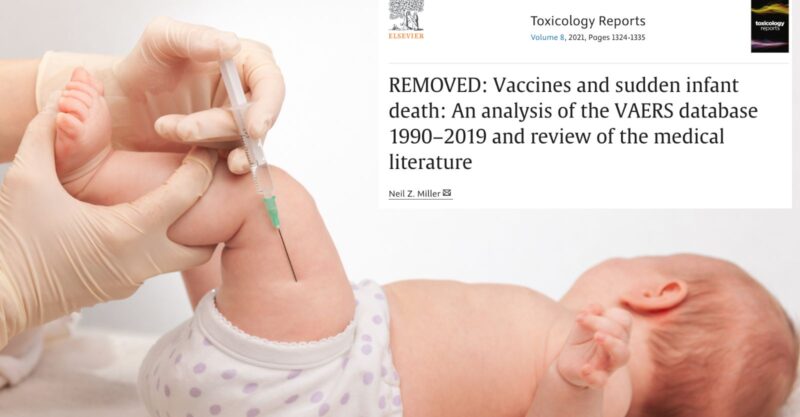
A peer-reviewed scientific paper examining the timing of reported infant deaths following vaccination has been removed from the scientific record nearly five years after it was originally published.
The decision has reignited debate over scientific transparency, vaccine safety research, and the limits of academic discourse.
The paper, “Vaccines and Sudden Infant Death: An Analysis of the VAERS Database 1990–2019 and Review of the Medical Literature,“ by medical research journalist Neil Z. Miller, was published in Toxicology Reports in June 2021. In April 2026, following complaints alleging methodological flaws, Elsevier removed the article from its journal rather than issuing a correction or retraction.
The decision has prompted criticism from researchers and free speech advocates, who argue that removing a peer-reviewed paper—rather than issuing a correction, editorial note, or retraction—sets a troubling precedent for scientific debate.
A Rare Removal from the Scientific Record
Scientific publishers have several mechanisms for addressing concerns about published research, including corrections, expressions of concern, and retractions. Complete removal is rare and is generally reserved for exceptional circumstances, such as legal issues or material considered to pose a serious public health risk.
In its removal notice, Elsevier stated that concerns centered on the paper’s use of data from the U.S. Vaccine Adverse Event Reporting System (VAERS) to evaluate temporal associations between vaccination and sudden infant death syndrome (SIDS). The publisher said the author’s responses did not adequately address those concerns and concluded that the article’s recommendations and conclusions “may pose potential risks to public health.”
Miller disputes that assessment and has publicly opposed the decision.
What the Study Found
Miller analyzed 2,605 reports of infant deaths submitted to VAERS between 1990 and 2019, including 1,048 reports classified as sudden infant death syndrome (SIDS).
His analysis found:
- 58% of reported infant deaths occurred within three days of vaccination.
- Approximately 78% occurred within seven days.
- Similar temporal clustering was observed among SIDS reports.
- The clustering was statistically significant.
Importantly, Miller did not claim that his analysis proved vaccines cause SIDS. Instead, he concluded that the observed patterns represented a safety signal warranting further investigation.
The paper stated:
“While the findings in this paper are not proof of an association between infant vaccines and infant deaths, they are highly suggestive of a causal relationship.”
Miller argued that identifying temporal patterns should encourage additional research into biological mechanisms, vaccine safety, cause-of-death classification, and improvements to post-market surveillance.
Understanding VAERS
VAERS is the U.S. national passive vaccine safety surveillance system jointly managed by the Centers for Disease Control and Prevention (CDC) and the U.S. Food and Drug Administration (FDA).
The system accepts reports from healthcare providers, patients, caregivers and others following vaccination. Because reports alone cannot establish causation, public health agencies emphasize that VAERS is designed to detect potential safety signals requiring further study—not determine causation.
At the same time, VAERS serves as one of the primary tools regulators use to identify possible safety concerns after vaccines enter widespread use.
Supporters of Miller’s work argue that while VAERS has important limitations, observed temporal patterns should be investigated rather than dismissed outright.
The Broader Scientific Context
Miller’s paper also reviewed previously published literature examining possible associations between vaccination and sudden infant death.
According to the review, several earlier studies and post-marketing safety reports documented similar clustering of reported infant deaths shortly after vaccination. The paper also discussed proposed biological mechanisms that some researchers have suggested could warrant further investigation, including inflammatory responses and neurological effects in vulnerable infants.
Other studies have reached different conclusions, and major public health agencies continue to maintain that available evidence does not establish vaccines as a cause of SIDS.
The debate illustrates the ongoing challenge of interpreting passive surveillance data and determining when observed patterns justify additional research.
Concerns About Scientific Censorship
Critics argue that the removal raises broader questions about how controversial scientific findings should be handled.
Ordinarily, disputed research remains available to readers alongside published critiques, corrections, or rebuttals. Removing a paper entirely makes it difficult for researchers, physicians and the public to independently evaluate both the evidence and the criticisms.
Supporters of the decision argue that studies with methodological limitations can be misinterpreted and potentially influence medical decision-making.
Opponents counter that scientific progress depends on open examination of evidence—even when findings challenge prevailing assumptions.
Calls for Better Vaccine Safety Monitoring
The controversy has also renewed attention on long-standing discussions about improving vaccine safety surveillance.
A federally funded project conducted by researchers at Harvard Medical School between 2007 and 2010 concluded that adverse events following vaccination are substantially underreported to VAERS and recommended developing more automated, active surveillance systems integrated with electronic health records.
More robust surveillance systems, proponents argue, could provide more complete safety data while reducing reliance on passive reporting databases alone.
Transparency and Public Trust
Questions surrounding vaccine safety are often highly polarized. Yet many researchers agree that maintaining public trust requires transparent investigation of safety signals, open scientific debate, and rigorous evaluation of evidence.
Whether one agrees with Miller’s conclusions or not, the removal of a peer-reviewed paper—rather than allowing it to remain available alongside published critiques—has intensified discussion about the role of publishers in determining which scientific findings remain part of the public record.
As debates over vaccine safety continue, many observers argue that open access to scientific evidence, coupled with robust peer review and transparent critique, is essential to maintaining confidence in both science and public health.
Sources:
Miller, N.Z. (2021). Vaccines and Sudden Infant Death: An Analysis of the VAERS Database 1990–2019 and Review of the Medical Literature. Toxicology Reports. (Article removed by Elsevier in April 2026.)
Hooker, B. (2021). “58% of Infant Deaths Reported to VAERS Occurred Within 3 Days of Vaccination, Research Shows.” The Defender, Children’s Health Defense. August 3, 2021.
Barnett, R. (2026). “Study Linking Vaccines to SIDS Deleted.” Dystopian Down Under (Substack).
June 2, 2026.
*********************************************************************************************************************************