
Heavy Metals and Infant Exposure: What Parents Need to Know About Diaper Creams and Baby Formula
Independent testing reveals avoidable heavy-metal exposure in products marketed for infants
Parents reasonably assume that products designed for babies are held to the highest safety standards. Diaper creams are applied to the most delicate skin, often multiple times a day. Infant formula may serve as a baby’s sole source of nutrition during critical periods of growth and brain development.
Recent independent testing and government-released data have raised serious questions about whether those assumptions are justified.
Two separate reports—one examining diaper creams and another focused on infant formula—highlight a shared concern: avoidable exposure to toxic heavy metals during infancy, a uniquely vulnerable stage of life.
Diaper Creams and Unexpected Heavy-Metal Findings
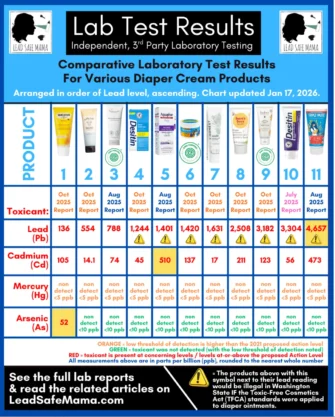
In January 2026, pediatrician Michelle Perro, MD summarized laboratory findings published by Lead Safe Mama showing detectable levels of toxic heavy metals, including lead and cadmium, in several popular diaper creams and salves.
Diaper creams are not occasional-use products. They are often applied at every diaper change and frequently to skin that is inflamed or broken. Infant skin is thinner and more absorbent than adult skin, and babies lack mature detoxification pathways. As a result, even low-level contamination can become biologically meaningful when exposure is repeated day after day.
According to the testing cited:
-
Lead and cadmium were detected in multiple diaper creams
-
Levels varied widely between brands and formulations
-
Products marketed as “natural,” “organic,” or “clean” were not exempt
-
Mercury was not detected, and arsenic was largely absent
The metals identified were not intentionally added. They are believed to enter products through contaminated raw materials, particularly mineral-based ingredients such as zinc oxide, clays, pigments, or botanical powders. Finished products are not routinely tested for heavy metals before reaching store shelves.
An Important Gap in Testing
One notable omission from the testing was aluminum. This does not mean aluminum is absent from diaper creams; rather, it reflects a limitation of the testing scope, not a declaration of safety. Aluminum compounds are widely used in personal-care products and may also be present as contaminants in mineral ingredients.
In infancy—especially when applied repeatedly to inflamed or broken skin—aluminum exposure warrants the same scrutiny as lead and cadmium. Its exclusion underscores the need for broader, more comprehensive testing of infant personal-care products.
Practical Risk-Reduction Steps
Dr. Perro emphasizes reducing unnecessary exposure rather than panic. Suggested steps include:
-
Avoiding routine, preventive diaper-cream use
-
Using barrier products only when truly necessary
-
Choosing products with fewer ingredients
-
Increasing diaper-free time and frequent diaper changes
-
Using gentle cleansing practices
Persistent diaper rashes may also signal underlying issues—such as moisture imbalance, yeast, food sensitivities, or antibiotic exposure—that topical products alone cannot resolve.
Infant Formula Testing Raises Broader Exposure Questions
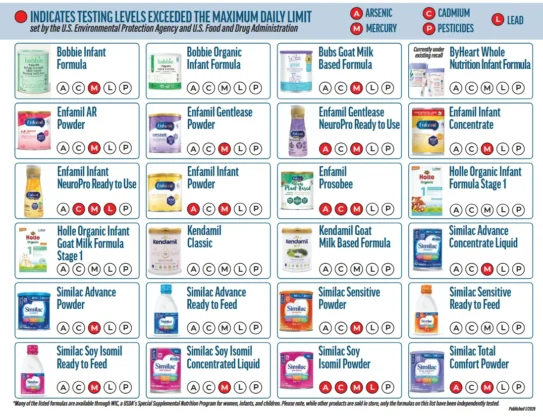
In January 2026, physician-scientist Ana Maria Mihalcea, MD, PhD reviewed findings from a Florida Department of Health initiative that tested 24 widely available infant formulas.
According to the state’s published results, 16 of the 24 formulas contained elevated levels of one or more toxic heavy metals, including lead, cadmium, mercury, and arsenic.
The testing was conducted under Florida’s Healthy Florida First initiative and publicly released to inform parents and caregivers. State officials framed the disclosure as a transparency measure intended to give families more information when making feeding decisions.
Why Formula Exposure Is Especially Concerning
Infant formula may be consumed multiple times per day and is often a baby’s sole source of nutrition. Heavy metals are known to bioaccumulate in the body, and early-life exposure has been associated in scientific literature with long-term neurological, immune, and developmental harm.
The Florida findings raise broader questions about:
-
Ingredient sourcing and manufacturing practices
-
The adequacy of existing federal testing requirements
-
Whether current safety thresholds adequately reflect infant vulnerability
While officials emphasized parental choice and accountability, the results suggest systemic challenges, rather than isolated product failures.
Important Context
Dr. Mihalcea’s report extends beyond the Florida testing results to advocate for widespread toxic-metal screening and detoxification strategies. These views go beyond established pediatric standards of care and are not universally accepted within conventional medicine.
However, the infant formula testing results themselves—released by Florida health authorities—stand independently of those broader claims and warrant serious consideration.
A Shared Lesson: Labels Are Not Safety Guarantees
Across both diaper creams and infant formula, one message is clear: marketing claims do not replace finished-product testing.
Terms such as “baby-safe,” “natural,” “clean,” or “pediatrician-recommended” are largely unregulated and do not require comprehensive screening for heavy-metal contamination. Even third-party endorsements often focus on ingredient lists, rather than contamination testing of the final product.
For parents, this creates an unreasonable burden—being asked to trust reassurance rather than verified safety.
Why This Matters for Canadian Families
Infancy is a critical window for neurological, immune, and metabolic development. The diaper area is highly vascular, and dietary exposure through formula is direct and repetitive. In this context, chronic low-level exposure to toxic metals is not trivial.
Canadian families deserve transparent testing, stronger safety standards and regulatory oversight that reflects the unique vulnerability of infants—not assumptions of safety based on labeling or marketing.
Reducing unnecessary exposures through minimal product use, simpler formulations, and informed feeding choices remains one of the few tools currently available to parents.
The Bottom Line
Diaper creams and infant formula are not minor lifestyle products. They are daily exposures during the most sensitive stage of human development.
Parents are not asking for perfection. They are asking for honest testing, meaningful disclosure, and standards that prioritize children’s health over convenience or branding.
Babies deserve more than reassuring labels. They deserve products proven to be safe.
Sources:
Perro, Michelle. (2026). What Parents Can Do About Diaper Creams After Disturbing Heavy-Metal Test Results. Substack.
Mihalcea, A. M. (2026). Florida Initiative Finds Arsenic, Mercury, Lead & Cadmium in Infant Formula. Substack.
***************************************************************************************************************************
If you find value in the work we do at Children’s Health Defense Canada, please consider making a donation so we may continue to advocate for and protect our most valuable resource…our children.