Federal Government Rebrands Failed Vaccine Injury Program After Years of Mismanagement
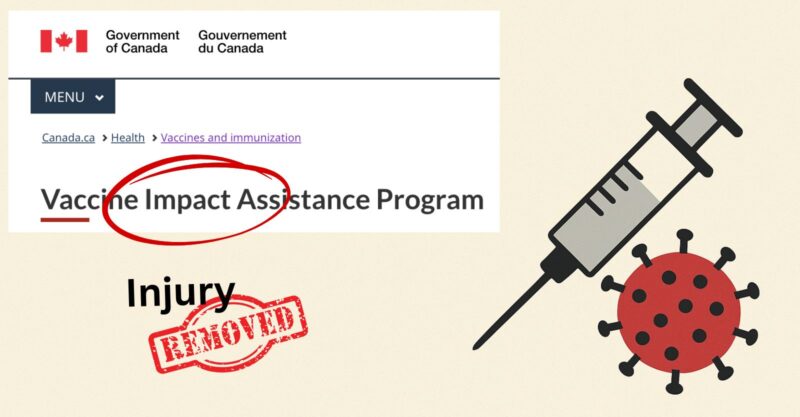
Canada’s troubled Vaccine Injury Support Program (VISP) has been quietly scrapped and rebranded as the Vaccine Impact Assistance Program (VIAP)—a move critics say does little to address the program’s well-documented failures.
As of April 1, 2026, the federal government has taken direct control of the program from private contractor Oxaro and relaunched it under a new name, promising improved efficiency, transparency, and support for injured Canadians.
But for Canadians harmed following COVID shots, the rebrand raises a more troubling question:
is anything actually changing?
A Program Plagued by Delays, Costs and Frustration
VISP was introduced in 2021 as a “no-fault” compensation program for individuals who experienced serious and permanent injury following a Health Canada–authorized injection.
Yet investigations revealed a system overwhelmed by bureaucracy and inefficiency.
Of the $54 million allocated to run the program, roughly two-thirds was spent on administration, while just over $21 million reached injured individuals.
Hundreds of applicants reported years-long delays, poor communication, and denied or stalled claims, leaving many without support while navigating life-altering injuries.
Now, those same unresolved claims—along with a growing backlog—are being transferred into the newly branded VIAP.
Same Program, New Name
The federal government says VIAP will “better support” Canadians and improve the claims process, including addressing backlogs and introducing a digital portal.
But structurally, the program remains largely unchanged.
VIAP continues to operate as a no-fault system, requiring medical experts to determine whether an injection “likely” caused an injury before compensation is granted.
Applicants must still navigate a complex process requiring extensive documentation, medical validation, and strict timelines—barriers that have already left many Canadians behind.
Even under the new framework, eligibility decisions cannot be appealed, limiting recourse for those denied support.
Backlog, Red Tape—and No Accountability
While officials claim the new program will be more “efficient,” they also acknowledge a significant backlog of applications—many dating back years.
Some applicants who were previously denied due to arbitrary deadlines are now being reconsidered, an implicit admission that the original system failed those it was meant to help.
Yet there has been no meaningful accountability for the mismanagement of tens of millions in taxpayer funds.
Instead, Canadians are being asked to trust that a renamed program—run by the same federal system that oversaw its failures—will now deliver results.
Informed Consent Still Missing From the Conversation
At its core, the existence of this program raises a fundamental issue that continues to be ignored: informed consent.
Canadians were assured that COVID shots were safe and necessary. Those who questioned the rollout were dismissed, censored, or coerced.
Now, with thousands of claims filed and a compensation program quietly restructured, the reality is harder to ignore: injuries happened—and continue to be acknowledged only after the fact.
A Rebrand Isn’t Reform
The shift from VISP to VIAP may signal a change in administration—but for the thousands of injured Canadians, the real test is whether it delivers timely, transparent and fair compensation.
So far, the federal government has offered a new name, new messaging, and familiar promises.
What it has not yet demonstrated is accountability—or a genuine commitment to those whose lives have been permanently altered.
Sources:
Government of Canada — Transition + program changes (VIAP) Press Release
Vaccine Impact Assistance Program (VIAP) overview
Public Health rebrands Canada’s failing vaccine injury program to ‘impact assistance’ after years of controversy
‘Impact,’ akin to a fender-bender or a minor inconvenience; something that just… happened.
Watch to unpack new details with @TamaraUgo: https://t.co/fFGRoS0JnM— Rebel News (@RebelNewsOnline) April 2, 2026
They Removed The Word “INJURY” – Canada’s Shocking VACCINE DAMAGE COVER-UP Exposed!!
Canada just quietly rebranded its Vaccine Injury Support Program, they literally removed the word “INJURY” from the title.
As of April 1st, the old VISP is gone and in its place is the shiny… pic.twitter.com/R4nio5qs4O
— Dan Dicks (@DanDicksPFT) April 3, 2026
*******************************************************************************************************