

Declassified Documents Raise Questions About U.S. Bioweapons Experiments and Origins of Lyme Disease
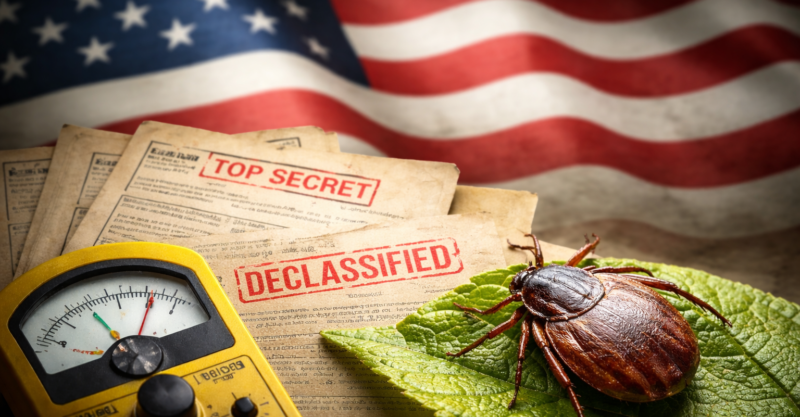
An explosive new investigation links declassified U.S. government documents to origins of Lyme disease.
The findings point to Cold War biological weapons research, large-scale tick experiments and decades of suppressed scientific data that may have shaped the modern Lyme epidemic in North America.
Reported by physician-scientist Dr. Robert W. Malone, the investigation examines newly available records related to U.S. biological weapons programs during the Cold War. The documents describe experiments involving disease-carrying insects and environmental releases designed to study how pathogens spread.
While Lyme disease is known to occur naturally and the bacteria responsible for it have circulated in North American ecosystems for thousands of years, the report raises questions about whether military research may have influenced how the disease emerged and spread in the modern era.
Today, Lyme disease has become one of the fastest-growing vector-borne illnesses in North America.
Massive Tick Experiments
According to the investigation, U.S. military researchers conducted large-scale experiments involving ticks during the 1960s.
Between 1966 and 1969, researchers reportedly released 282,800 lone star ticks labeled with radioactive Carbon-14 across several sites in Virginia. The radioactive markers allowed scientists to track the insects using Geiger counters in order to study how ticks spread through the environment.
The release sites were reportedly located along major bird migration routes, allowing researchers to observe how ticks might travel long distances.
At the time, lone star ticks were not commonly found north of the Mason-Dixon Line. Within a few years, populations began appearing farther north — including on Long Island.
Cold War Biological Weapons Programs
The experiments were reportedly connected to Project 112, a major U.S. biological and chemical weapons testing program authorized in 1962 by Defense Secretary Robert McNamara.
Project 112 involved dozens of experiments designed to evaluate how biological agents might spread through the environment and affect humans, animals and equipment. The program involved multiple branches of the U.S. military and remained classified for decades before being acknowledged publicly in 2000.
Some tests explored whether insects such as mosquitoes, fleas or ticks could potentially serve as vectors for biological warfare agents.
The Plum Island Question
Another focus of the investigation is the Plum Island Animal Disease Center, a U.S. federal research facility located off the coast of Long Island, New York.
The facility has studied livestock diseases since the 1950s and has long been the subject of speculation because of its proximity to Lyme, Connecticut — the town where Lyme disease was first identified in the 1970s.
Some researchers and investigative journalists have suggested that laboratory experiments or accidental releases could have contributed to the emergence of tick-borne diseases in the region.
However, government agencies have repeatedly stated that Lyme disease research was not conducted at the facility and that the disease existed in North American wildlife long before the laboratory was established.
Suppressed Research Into Co-Infections
The investigation also highlights previously unpublished materials belonging to Willy Burgdorfer, the scientist who identified the bacterium linked to Lyme disease in 1982.
According to the report, Burgdorfer’s private research notes suggested he had detected evidence of additional pathogens in Lyme patients during early investigations in the late 1970s.
Those findings were not included in the landmark study that first identified the Lyme disease bacterium. Some researchers now believe the missing data could help explain why many patients experience complex or chronic symptoms even after treatment.
Lyme disease is caused primarily by the bacterium Borrelia burgdorferi, which is transmitted to humans through the bite of infected ticks.
Congressional Investigation
Concerns about military experiments involving ticks have previously reached the U.S. Congress.
In 2019, lawmakers passed an amendment directing the Pentagon to review whether the U.S. military experimented with ticks or other insects as biological weapons between 1950 and 1975 — and whether any were released outside laboratory environments.
The inquiry was prompted by books and investigative reports suggesting that Cold War research programs may have explored using insects to spread disease.
Why This Matters for Canada 🇨🇦
Although the experiments described occurred in the United States, the implications extend well beyond its borders.
Lyme disease has been increasing steadily in Canada over the past two decades as ticks carrying the bacteria expand into new regions. Ontario, Quebec, Nova Scotia and Manitoba have seen some of the fastest growth in reported cases.
Migratory birds play a major role in spreading ticks across North America. Each year, birds travel between the northeastern United States and Canada, carrying ticks across the border and helping establish new populations.
If historical laboratory experiments influenced tick populations or pathogen behavior in the northeastern U.S., those effects would not remain confined to one country.
Canada shares ecosystems with the same regions where Lyme disease first emerged in the 1970s, including the Long Island Sound area. Understanding the full history of the disease’s spread could help researchers better understand how tick-borne illnesses evolve — and how they should be treated.
The Need for Transparency
Lyme disease continues to affect hundreds of thousands of people across North America every year, and many patients report long-term symptoms that remain difficult to diagnose or treat.
Advocates say that gaining access to historical biological weapons research records could help scientists better understand the disease and its possible co-infections.
The investigation concludes that when biological research programs operate in secrecy for decades, critical information about public health risks may remain hidden.
For patients living with Lyme disease today, those unanswered questions are more than historical curiosity — they may hold important clues about how the illness developed and how it can be treated in the future.
“Are you saying Lyme disease was a government engineered bio-weapon?…” https://t.co/cN1wikinKJ pic.twitter.com/JEs57GtD78
— Died Suddenly (@DiedSuddenly_) March 5, 2026
Source:
Dr. Robert Malone, Malone News on Substack
**************************************************************************************************************